
Presidential slogans have been part of American election campaigns for generations. They have appeared on posters, buttons, banners, songs, advertisements, and campaign merchandise. Some were built around a candidate’s name, while others emphasized a political issue, a promise, a mood, or a vision of the country.
This collection focuses on documented presidential campaign slogans rather than newly created campaign messages. It gives you historical examples, explains the different styles they used, and shows why some phrases became closely associated with particular elections. The Library of Congress documents campaign songs and slogans going back to the early presidential contests, while the National Archives preserves campaign materials spanning more than a century.
If you’re studying political history, creating an election-themed school project, researching campaign communication, or simply curious about famous political slogans, the examples below provide a useful starting point.
Presidential Slogans at a Glance
| Slogan or campaign phrase | Candidate | Election era | Main approach |
| Tippecanoe and Tyler Too | William Henry Harrison / John Tyler | 1840 | Rhyme and names |
| I Like Ike | Dwight D. Eisenhower | 1952 | Name-based |
| Keep Cool with Coolidge | Calvin Coolidge | 1924 | Name-based wordplay |
| Return to Normalcy | Warren G. Harding | 1920 | National mood |
| A Chicken in Every Pot | Herbert Hoover | 1928 | Economic promise |
| Happy Days Are Here Again | Franklin D. Roosevelt | 1932 | Optimistic campaign song/message |
| Forward with Roosevelt | Franklin D. Roosevelt | 1936 | Continuity |
| Give ‘Em Hell, Harry | Harry S. Truman | 1948 | Rallying expression |
| All the Way with LBJ | Lyndon B. Johnson | 1964 | Candidate-focused |
| In Your Heart, You Know He’s Right | Barry Goldwater | 1964 | Personal conviction |
| Make America Great Again | Ronald Reagan | 1980 | National vision |
| It’s Morning Again in America | Ronald Reagan | 1984 | Optimistic national image |
| Read My Lips: No New Taxes | George H. W. Bush | 1988 | Specific policy message |
| Don’t Stop Thinking About Tomorrow | Bill Clinton | 1992 | Future-oriented |
| Putting People First | Bill Clinton | 1992 | People-focused |
| Compassionate Conservatism | George W. Bush | 2000 | Ideological framing |
| Yes We Can | Barack Obama | 2008 | Collective optimism |
| Change We Can Believe In | Barack Obama | 2008 | Change-focused |
| Forward | Barack Obama | 2012 | Continuity and movement |
| Make America Great Again | Donald Trump | 2016 | National restoration |
| Build Back Better | Joe Biden | 2020 | Recovery and rebuilding |
These examples come from historical campaign materials and reference works; they are presented here as historical documentation rather than as recommendations about which political message readers should support.
Related Post: 100 Water Slogans That Rhyme
The Early Era of Presidential Slogans
Modern campaign branding did not appear overnight. Political communication in early American elections often used songs, printed material, symbols, and short phrases to associate candidates with particular ideas.
The Library of Congress notes that campaign songs became important tools during the nineteenth century and continued into the early twentieth century. They could repeat candidate names, political platforms, or campaign slogans.
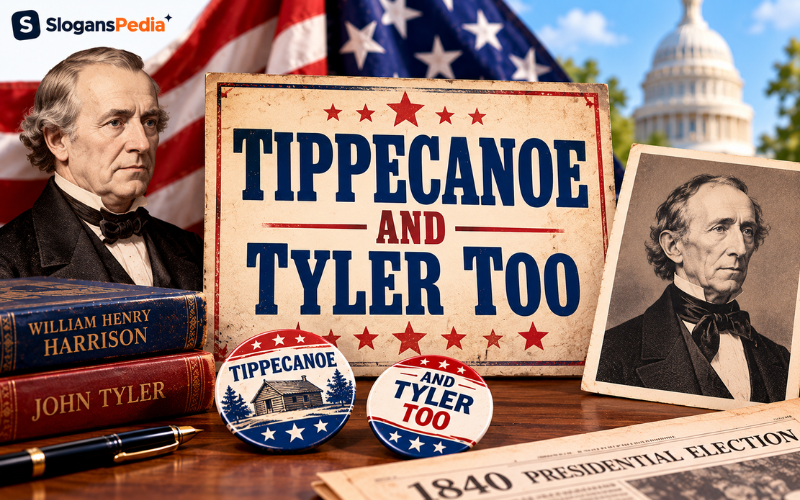
One of the best-known early examples is “Tippecanoe and Tyler Too,” associated with William Henry Harrison and John Tyler during the 1840 election.
The phrase worked partly because of its rhythm and rhyme. It also connected Harrison to his military reputation while making the ticket’s two names easy to remember. HISTORY notes that the slogan combined rhyme, rhythm, and alliteration.
Other nineteenth-century campaign material used similar techniques. Campaign songs could connect candidates with popular figures, political causes, patriotic themes, or memorable phrases.
The Library of Congress collection includes examples associated with elections involving Abraham Lincoln, Ulysses S. Grant, William McKinley, Grover Cleveland, Theodore Roosevelt, and others.
Famous Name-Based Presidential Slogans
A candidate’s name can be a surprisingly useful foundation for a campaign phrase.
“I Like Ike”
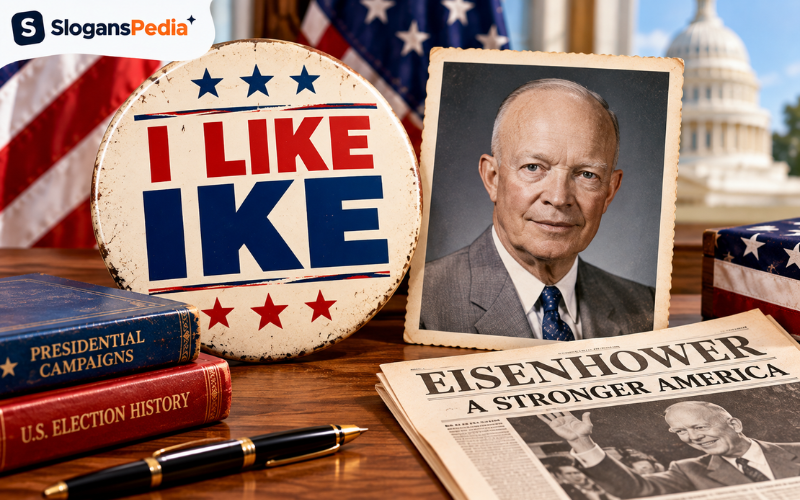
Dwight D. Eisenhower’s “I Like Ike” is one of the most recognizable examples.
The nickname “Ike” had been associated with Eisenhower since childhood. During the 1952 presidential campaign, the phrase appeared on buttons and posters and was also turned into campaign music.
Its structure was extremely simple. It did not attempt to explain a lengthy political platform. Instead, it created an easy association between the candidate’s nickname and a positive personal response.
The phrase remained useful in 1956, when the related expression “I Still Like Ike” appeared during Eisenhower’s reelection campaign.
“Keep Cool with Coolidge”
Calvin Coolidge’s campaign also used his surname as part of a memorable phrase.
“Keep Cool with Coolidge” used repetition and wordplay to make the candidate’s name part of the message. HISTORY identifies it as Coolidge’s 1924 campaign slogan.
“All the Way with LBJ”
Lyndon B. Johnson’s 1964 campaign used “All the Way with LBJ.”
The phrase is a straightforward example of a candidate-centered slogan. It was short, rhythmic, and built around a familiar abbreviation of the candidate’s name. The National Archives includes it among examples of presidential campaign slogans.
Presidential Slogans About Change
Another recurring approach is to frame an election around change, movement, or a different direction.
“Change We Can Believe In”
Barack Obama’s 2008 campaign used “Change We Can Believe In.”
The phrase connected the idea of change with a qualification: the change being discussed was presented as something supporters could believe in.
The 2008 campaign also became strongly associated with “Yes We Can.” A Library of Congress publication discussing political communication identifies the phrase in connection with Obama’s 2008 campaign.
“Forward”
Obama’s 2012 campaign used “Forward.”
The word provided a compact expression of continued movement. In campaign remarks from that election, Obama repeatedly described the choice as moving forward rather than backward.
These examples show how a single broad concept can become a central campaign theme without spelling out an entire policy program.
Related Post: 100 Anti Drug Slogans
Presidential Slogans About National Mood
Some campaign slogans have focused less on a candidate’s name and more on the mood of the country.
“Return to Normalcy”
Warren G. Harding’s 1920 campaign became associated with “Return to Normalcy.”
The National Archives identifies the phrase among presidential campaign slogans and campaign materials.
The slogan is historically notable because it framed the election around a desire for a particular national condition rather than simply emphasizing the candidate’s personality.
“It’s Morning Again in America”
Ronald Reagan’s 1984 campaign used “It’s Morning Again in America.”
The phrase presented an optimistic picture of the country and became associated with one of the era’s best-known campaign advertisements. Presidential campaign research also identifies Reagan’s campaign communication as an important example of image-based political advertising.
Presidential Slogans and Economic Messages
Economic conditions have frequently influenced presidential campaign messaging.
Herbert Hoover’s 1928 campaign became associated with “A Chicken in Every Pot and a Car in Every Garage.” HISTORY discusses the phrase in its review of presidential campaign slogans.
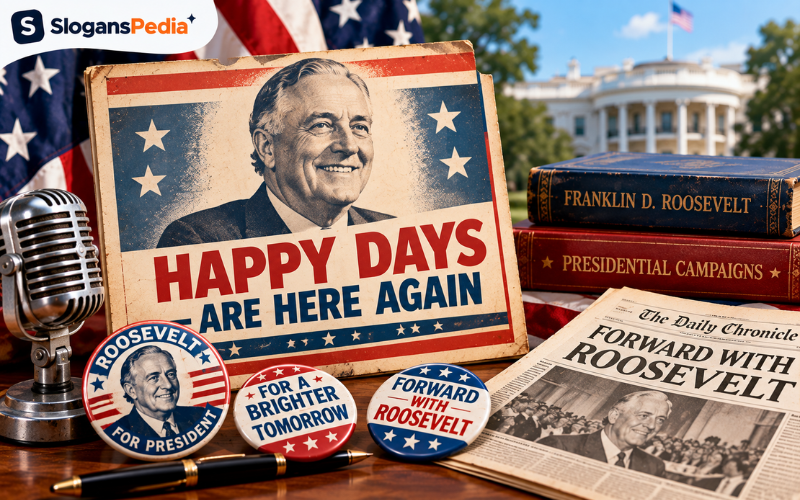
Franklin D. Roosevelt’s 1936 campaign used “Forward with Roosevelt,” emphasizing continuity with his administration. The Franklin D. Roosevelt Presidential Library and National Archives describe the phrase in connection with his reelection campaign.
These examples illustrate two different approaches: one describes a material aspiration, while the other emphasizes continuing an existing direction.
Presidential Slogans Based on Policy
Some campaign phrases have been much more specific.
George H. W. Bush’s 1988 campaign became associated with “Read My Lips: No New Taxes.” The phrase was considerably more specific than a general slogan about optimism or change. It communicated a particular position in a handful of words.
Barry Goldwater’s 1964 campaign used “In Your Heart, You Know He’s Right.” The National Archives’ Reagan Library notes both the phrase and the way Lyndon Johnson’s campaign later parodied it in its own advertising.
This demonstrates an important feature of campaign language: a slogan can become part of a political contest in which opposing campaigns respond directly to one another’s messages.
Related Post: 40 Funny Student Council Slogans
Why Presidential Slogans Are Usually Short
Short phrases are easier to place on campaign buttons, posters, signs, newspaper advertisements, and other physical materials.
Historical campaign material shows just how important these objects were. The Smithsonian notes that signs, slogans, campaign buttons, and other political artifacts provide snapshots of the campaigns and their political environment.
The Library of Congress also documents how campaign songs helped repeat candidate names, platforms, and slogans to audiences.
That does not mean every successful slogan has to be extremely short. Rather, a campaign phrase needs to be recognizable and repeatable enough to work across different forms of communication.
Presidential Slogans and Rhyming
Rhyming has appeared throughout American campaign history.
“Tippecanoe and Tyler Too” is an especially clear historical example. Its sound helped make the phrase memorable. HISTORY specifically points to rhyme, rhythm, and alliteration as features that helped make it notable.
Name-based rhymes also appeared in later campaigns. Some were serious, while others were deliberately playful.
The use of rhyme has one obvious advantage: it gives a phrase a predictable rhythm. But historical campaigns also demonstrate a potential downside. A rhyme can become awkward when the wording is forced simply to make two words sound alike.
Presidential Slogans and Campaign Songs
Before television and social media, campaign songs were an important part of presidential campaigning.
The Library of Congress has preserved campaign songs from elections reaching back to the late eighteenth century. These songs were performed publicly and privately, printed as sheet music, and used to promote candidates or political causes.
The 1904 election, for example, produced campaign songs associated with Theodore Roosevelt, Alton B. Parker, and Eugene V. Debs. Later examples include campaign songs connected with William Howard Taft, Warren G. Harding, Franklin Roosevelt, Richard Nixon, John F. Kennedy, and others.
This history helps explain why rhythm and repetition became so closely connected with political messaging.
Presidential Slogans From the 20th Century
Here are additional documented examples, arranged chronologically rather than ranked:
- “Return to Normalcy” — Warren G. Harding, 1920
- “Keep Cool with Coolidge” — Calvin Coolidge, 1924
- “A Chicken in Every Pot and a Car in Every Garage” — Herbert Hoover, 1928
- “Forward with Roosevelt” — Franklin D. Roosevelt, 1936
- “I Like Ike” — Dwight D. Eisenhower, 1952
- “I Still Like Ike” — Dwight D. Eisenhower, 1956
- “All the Way with LBJ” — Lyndon B. Johnson, 1964
- “In Your Heart, You Know He’s Right” — Barry Goldwater, 1964
- “Don’t Stop Thinking About Tomorrow” — Bill Clinton, 1992
- “Putting People First” — Bill Clinton, 1992
- “Compassionate Conservatism” — George W. Bush, 2000
The National Archives’ presidential slogan collection includes many of these examples across different elections and candidates.
Presidential Slogans From the 21st Century
Political campaigns in the 2000s increasingly operated across television, websites, social networks, email, online video, and physical campaign materials.
Some documented examples include:
- “Yes We Can” — Barack Obama, 2008
- “Change We Can Believe In” — Barack Obama, 2008
- “Forward” — Barack Obama, 2012
- “Make America Great Again” — Donald Trump, 2016
- “Build Back Better” — Joe Biden, 2020
The National Archives describes presidential campaign slogans as part of a broader visual and material culture that includes buttons, banners, posters, logos, and other campaign objects.
What Makes a Presidential Slogan Memorable?
Historical examples reveal several recurring characteristics.
1. Brevity
A short phrase can fit on a button, sign, poster, or banner.
2. Repetition
Campaigns need messages that can be repeated across speeches, advertisements, merchandise, and other communications.
3. Rhythm
Rhythm can make a phrase easier to say and remember. “Tippecanoe and Tyler Too” is a classic historical example.
4. A Clear Theme
Some slogans emphasize a candidate’s identity. Others focus on change, continuity, economic concerns, national mood, or a specific policy.
5. Adaptability
A useful campaign phrase can appear in several formats without becoming difficult to recognize.
Presidential Slogan Styles at a Glance
| Style | What it emphasizes | Historical example |
| Name-based | Candidate identity | “I Like Ike” |
| Rhyming | Sound and memorability | “Tippecanoe and Tyler Too” |
| Change-focused | Direction or transformation | “Change We Can Believe In” |
| Continuity-focused | Continuing an existing direction | “Forward with Roosevelt” |
| Policy-focused | A specific political position | “Read My Lips: No New Taxes” |
| Optimistic | Positive national mood | “It’s Morning Again in America” |
| Future-focused | Looking ahead | “Don’t Stop Thinking About Tomorrow” |
These categories describe how documented slogans functioned; they are not a ranking of their effectiveness. Historical sources show that presidential slogans have served many different communication purposes over time.
How to Study a Presidential Slogan
If you’re researching a slogan for a school assignment or history project, don’t look only at the words.
Ask four simple questions:
Who used it?
Identify the candidate, campaign, party, and election year.
What was happening at the time?
Economic conditions, wars, social issues, and public attitudes can help explain why a particular theme appeared.
Where did people see it?
Look for buttons, posters, advertisements, campaign songs, speeches, newspapers, and other material.
What was the phrase trying to communicate?
Some slogans highlighted a candidate’s name. Others presented a broad national mood or a specific political position.
The Library of Congress and National Archives collections are particularly useful because they preserve original campaign materials rather than relying only on modern summaries.
Common Mistakes When Researching Presidential Slogans
Confusing a slogan with a speech quote
A memorable sentence from a political speech is not automatically a campaign slogan. Check the original campaign material before labeling it as one.
Assuming every phrase was an official slogan
Campaigns often used several phrases at the same time. Posters, advertisements, songs, speeches, and merchandise could emphasize different messages.
Ignoring the election year
The same candidate could use different messages during different campaigns. Eisenhower, for example, was associated with both “I Like Ike” in 1952 and “I Still Like Ike” in 1956.
Treating historical slogans as timeless political advice
A slogan belongs to its political and historical context. A phrase that made sense in one election may communicate something very different decades later.
FAQs
What is a presidential slogan?
A presidential slogan is a short phrase associated with a candidate’s campaign for the U.S. presidency. Campaigns have used slogans to communicate candidate identity, political themes, policy positions, national mood, or ideas about change and continuity.
What is one of the oldest famous presidential slogans?
“Tippecanoe and Tyler Too,” associated with William Henry Harrison and John Tyler during the 1840 election, is one of the best-known early U.S. presidential campaign slogans. Its rhyme and rhythm helped make it memorable.
What was Dwight Eisenhower’s slogan?
Eisenhower’s 1952 campaign became strongly associated with “I Like Ike.” The phrase appeared on campaign buttons, posters, and songs. His 1956 reelection campaign also used the related phrase “I Still Like Ike.”
Why do presidential slogans use rhyme?
Rhyme can make a phrase easier to remember and repeat. Historical campaign material provides several examples of rhyme, rhythm, and wordplay being used in presidential elections.
Have presidential campaigns always used slogans?
Political campaigns have used short phrases, songs, symbols, and printed messages for a very long time. The Library of Congress documents presidential campaign songs and related slogans from the late eighteenth century onward.
Where can I research historical presidential slogans?
The Library of Congress and U.S. National Archives are useful starting points. Their collections contain campaign songs, posters, slogans, buttons, and other historical campaign materials.
Can a phrase from a presidential campaign be used commercially?
Not automatically. A historical phrase may have trademark, copyright, publicity, or other legal considerations depending on how it is being used. For commercial use, check the relevant trademark databases and seek qualified legal advice.
Conclusion
Presidential slogans offer a compact way to study how American political campaigns have communicated with voters. From “Tippecanoe and Tyler Too” and “I Like Ike” to later phrases built around change, continuity, policy, and national identity, the style of campaign messaging has changed considerably over time.
For research purposes, the most useful approach is to look beyond the phrase itself. Consider the election year, the campaign’s broader communication, the historical circumstances, and where the slogan appeared. The Library of Congress and National Archives provide valuable primary and archival material for doing that research.
Pingback: 80 Slogans About Social Media for Awareness, Safety, School & More